
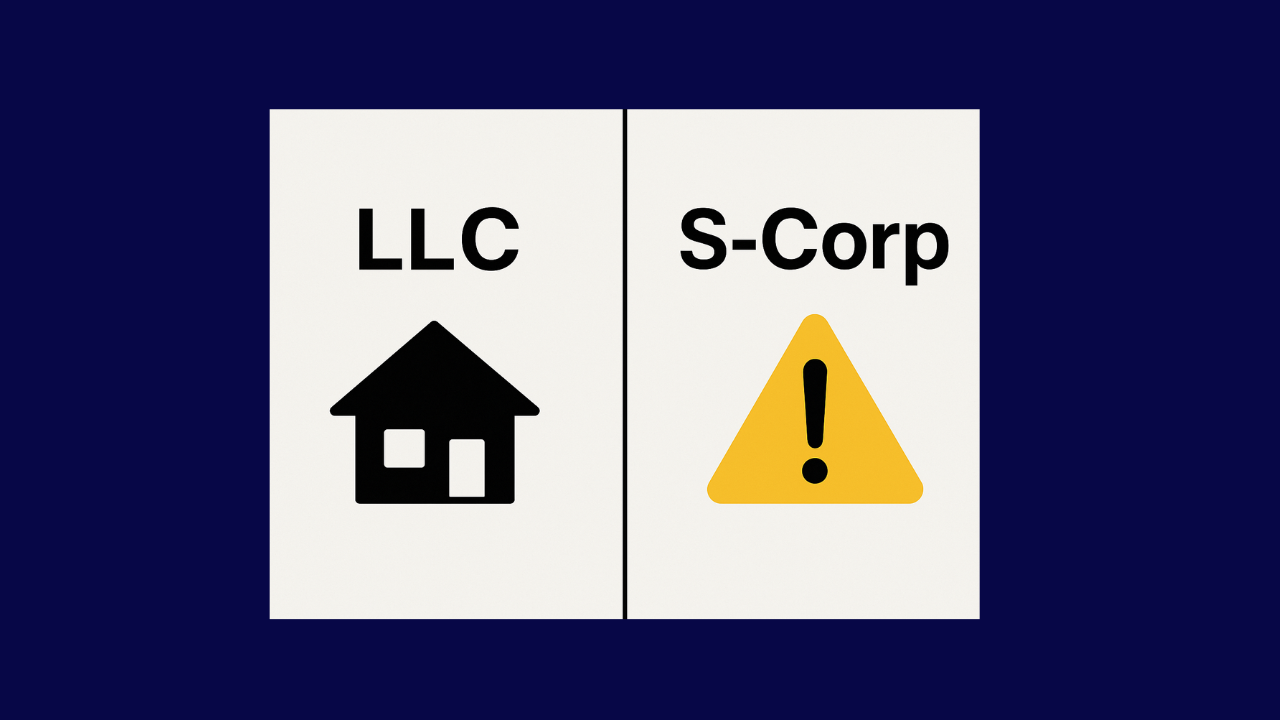
While S-Corps work beautifully for active businesses, they’re usually a poor fit for holding rental real estate. In most cases, other structures—especially LLCs—offer more flexibility, better tax outcomes, and far fewer long-term headaches.
Below are the key reasons investors should think twice before placing rental property inside an S-Corp.
1. Passive Rental Income Doesn’t Get the Typical S-Corp Advantage
S-Corps shine when you’re running an active business because they can reduce self-employment taxes. But rental income is generally passive under IRS rules unless you materially participate.
For most landlords, this means the S-Corp produces no meaningful tax benefit—yet you still take on payroll requirements, extra compliance, and less flexibility. You get the burden without the benefit.
2. Loss Deduction Limits Reduce the Value of Depreciation
A major tax advantage of rental real estate is depreciation and the ability to use losses to offset passive income. But S-Corps restrict how shareholders can deduct losses.
Your basis in an S-Corp does not increase from the entity’s mortgage debt.
LLCs/partnerships do add debt to basis, which is why investors can usually deduct more losses there.
For leveraged real estate (most rentals), this limitation significantly reduces tax savings.
3. Transfers and Distributions Can Trigger Taxable Events
S-Corps create rigidity that can lead to unexpected taxes:
-
Contributing property into an S-Corp can trigger gain if ownership tests aren’t met.
-
Distributing property out of an S-Corp is treated as a taxable sale at fair market value.
This becomes a major issue if you ever want to refinance, restructure ownership, add partners, or move the property into a different entity.
4. No Step-Up in Basis for the Property at Death
When a shareholder dies, heirs receive a step-up in basis in the stock, not in the underlying real estate held by the S-Corp.
In contrast, real estate held in an LLC taxed as a partnership can receive a step-up in the actual property through a §754 election.
This difference can create huge taxable gains for the next generation.
5. Strict Shareholder and Structural Rules
S-Corps have limitations that rarely align with real estate investing goals:
-
Maximum of 100 shareholders
-
Only U.S. citizens/residents and certain trusts can own shares
-
Only one class of stock allowed
If you ever want to bring in investors, create preferred returns, or structure deals creatively, the S-Corp becomes a roadblock.
Better Alternatives for Real Estate Investors
For rental real estate, investors typically get better outcomes with:
-
Single-member LLCs (for liability protection and simplicity)
-
Multi-member LLCs taxed as partnerships (for flexibility, debt-basis benefits, and estate planning options)
These structures align with how real estate actually appreciates, depreciates, and transfers across generations.
When an S-Corp Might Make Sense
An S-Corp could still be useful if you’re running an active real estate business:
property management, development, flipping, or short-term rentals where you materially participate.
But even then, it usually should not own the long-term rental property itself.
Final Takeaway
An S-Corp is powerful—but not for holding rental real estate.
Between limited loss deductions, transfer tax traps, no step-up in basis, and shareholder restrictions, most investors benefit more from an LLC structure.
If you’re evaluating the best entity for your real estate portfolio, it’s worth reviewing your goals, income profile, and long-term plans so you choose a structure that supports—not constrains—your growth.
Ready to Structure Your Real Estate Investments the Smart Way?
If you’re building a rental portfolio and want to avoid costly mistakes with your entity setup, I can help you choose the structure that protects your assets, lowers taxes, and supports long-term growth.
Book a consultation:
👉 https://calendly.com/hello-cktaxandbookkeeping



No comment yet, add your voice below!